Who Are The Concerned Citizens of Rivergrove?

Updated: Oct 4

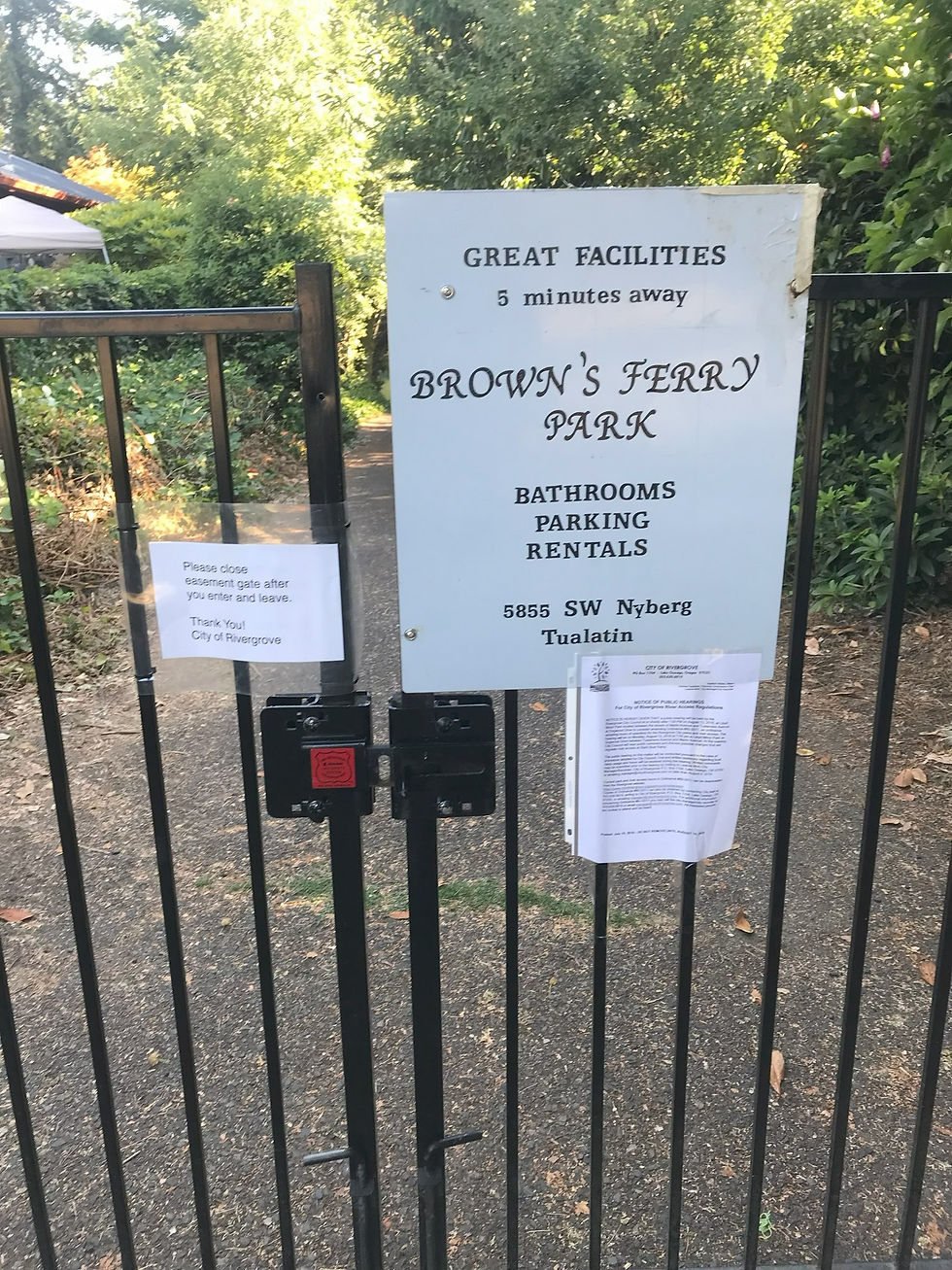
This is one of a dozen "No Parking" signs suddenly installed by Clackamas County near the Stark Boat Ramp in May 2025. Learn more at the bottom of this article.
What Role Are They Playing in Local Politics?
Public debate is healthy and necessary in local government. In Rivergrove, one of the most active participants in recent discussions about the Stark Boat Ramp, city governance, and local elections is a group known as Concerned Citizens of Rivergrove (CCR). Many residents may assume CCR is simply an informal neighborhood association or civic group. However, Oregon campaign-finance records identify the organization as a political action committee (PAC), formally registered as Rivergrove Concerned Citizens. In addition to advocating on local issues, the organization endorses candidates for public office and actively participates in local elections.
Like many residents, I began receiving CCR emails and postcards despite never signing up for them. Curious about who was behind the organization and what its goals were, I decided to look beyond rumors and review the public record. What emerges is a picture of a group whose members have played a significant role in both the ongoing Stark Boat Ramp controversy and Rivergrove's current political debates.
A Long History of Boat Ramp Disputes
The Stark Boat Ramp is not just another neighborhood amenity (see the 2021 Report by City Council on the Boat Ramp). For most Rivergrove residents, it represents the only practical public access point to the Tualatin River. While some riverfront properties enjoy direct access, many other households depend on the public ramp for boating, paddling, fishing, and other river recreation.
To be fair, living next to a public access facility can present challenges. Traffic, parking, noise, and seasonal crowds are legitimate concerns. Nobody should dismiss the frustrations of nearby residents. But public records show that concerns about the boat ramp have evolved into a long-running campaign seeking restrictions on public use.
According to City records, reports, petitions, and public hearings, nearby residents associated with this effort have:
Asked whether the ramp could be closed.
Advocated for shorter operating hours and additional limitations on public access.
Circulated petitions proposing further restrictions.
Supported rules limiting use to "one group at a time" for launching and retrieving boats.
Participated in disputes regarding parking and access near the ramp.
Challenged permits related to repair and reconstruction of the ramp through land-use appeals (see oral argument recording for Case 2026-025 Lahsene et al v. City of Rivergrove).
The City's own 2021 boat-ramp report concluded that many proposed restrictions could impair public access and potentially conflict with Rivergrove's stated policy of improving access to the Tualatin River.
Taken together, the public record reflects years of efforts to limit, regulate, or reduce use of the facility. Whether one views those efforts as responsible neighborhood advocacy or opposition to public access is a question each voter must answer for themselves.
Questions Worth Asking
The overlap between political advocacy, election activity, and ongoing boat-ramp disputes raises legitimate questions for Rivergrove voters:
Is CCR's primary focus broad government reform, or issues that directly affect nearby property owners?
How much influence should neighboring residents have over a public facility used by the broader community?
Do CCR-endorsed candidates share the organization's views regarding the boat ramp and related policies?
Would additional restrictions primarily benefit the community as a whole or nearby residents?
Why has a public boat ramp become such a central issue in local politics?
These are not accusations. They are fair questions that naturally arise from the public record.
Remember: CCR is a PAC
There is nothing inherently wrong with forming a PAC. Political action committees play a legitimate role in civic life.
However, voters should understand the distinction. A civic group typically exists to discuss issues and encourage community involvement. A PAC exists to influence elections and public policy. CCR itself promotes candidates for City Council and publishes political messaging regarding city governance, budgeting, land-use decisions, and other municipal issues.
That does not invalidate the organization's views. It does mean residents should evaluate those views in the same way they would evaluate statements from any political organization seeking to influence election outcomes.
Listen, but Verify
The most important point is not whether one agrees with CCR, City officials, or any particular candidate. The most important point is that residents examine the facts for themselves.
Public meetings, campaign filings, petitions, legal appeals, and City documents are available to anyone willing to review them. Reasonable people can disagree about how the Stark Boat Ramp should be managed. But those disagreements should be grounded in documented facts, not assumptions or rhetoric.
The strongest safeguard for good local government remains an informed public that asks questions, reviews the record, and reaches its own conclusions.
Brett Egusa
Brett4RG@gmail.com
Explanation of "No Parking" sign above: Clackamas County installed the No Parking signs at the request of the Concerned Citizens of Rivergrove, according to communications to the city, because CCR residents don't want people parking by the boat ramp. The City of Rivergrove had no knowledge of it, and there was no public process involved prior to the installation. CCR says they stand for "transparent government, responsible management and meaningful resident participation." Their actions say otherwise. The signs were removed at the request of the city.